- Top 10 SEO Strategies to Boost Your Google Rankings in 2027
- Why Your SEO Strategy Needs a Rethink Right Now
- The Core Problem: Visible, But Not Chosen
- What Businesses Need to Understand First
- What We See in Client Accounts
- Practical Strategy: The 10 SEO Strategies for 2027
- Step-by-Step Implementation: Your First 90 Days
- Common Mistakes to Avoid
- Expert Perspective
- Conclusion
- Frequently Asked Questions
Top 10 SEO Strategies to Boost Your Google Rankings in 2027
In short: Google rankings in 2027 will be won by pages that do three things at once. They match what the searcher actually wants, they show that a real person with real experience wrote them, and they get quoted by AI answers as well as ranked in the blue links. This guide covers the 10 SEO strategies we would prioritise for 2027, in the order we would tackle them, plus a 90-day plan and the mistakes we see most often. If you only have time for three, start with intent, technical health and original data.
Why Your SEO Strategy Needs a Rethink Right Now
Google began rolling out its November 2026 core update on 10 November, and it can take up to two weeks to settle. It is the third core update of the year, and it lands just ahead of the Black Friday rush, so rankings may shift just as the busiest shopping weeks begin.
Underneath that sits a bigger change. A randomised field study reported by Search Engine Journal found that AI Overviews cut organic clicks by 38% on the queries where they appeared. Pew Research data tells a similar story: people click a website on roughly 8% of searches that show an AI Overview, against 15% when there isn’t one. Ranking is still necessary. It is just no longer enough.
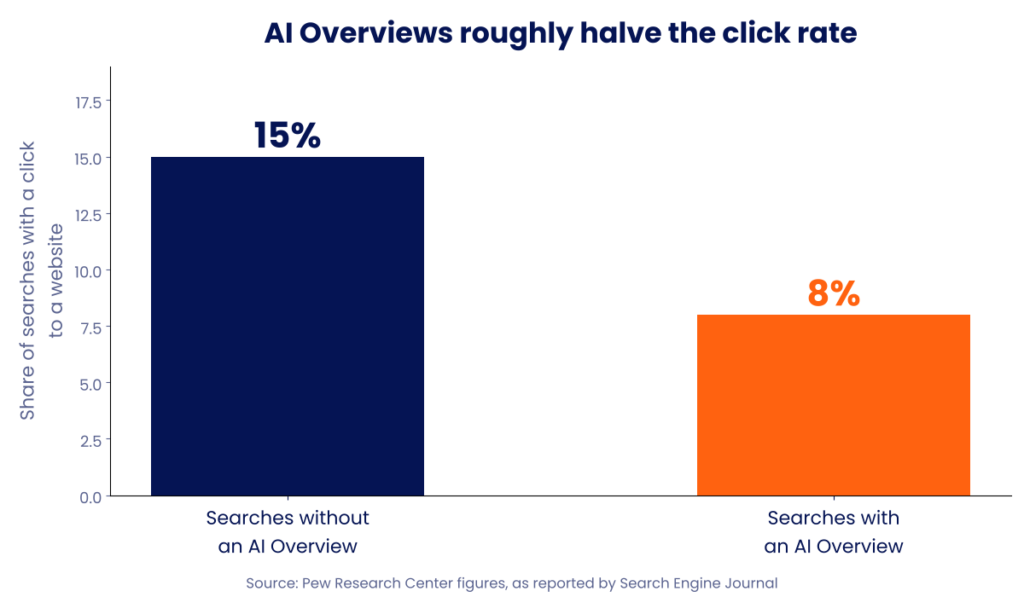
Source: Pew Research Center figures, as reported by Search Engine Journal.
The Core Problem: Visible, But Not Chosen
Most business sites we look at share one pattern: a decent homepage, a services page that reads like every competitor’s, and a blog that was last touched when someone remembered. Picture a Delhi interior designer who ranks for their own brand name but is invisible for “modular kitchen cost in Gurgaon”, the search a new customer actually types. Traffic is thin, and what arrives doesn’t convert. More posts rarely fix it. The gap is relevance, trust and clarity, not volume.
What Businesses Need to Understand First
Three ideas shape everything below. First, Google now ranks pages and also selects sources: AI answers draw on a small set of pages the system trusts, so being quotable matters as much as being ranked. Second, search intent beats keywords. A page that matches the intent but misses the exact phrase usually outperforms the reverse. Third, rankings are a means, not the goal. Leads, calls and sales are the scoreboard.
What We See in Client Accounts
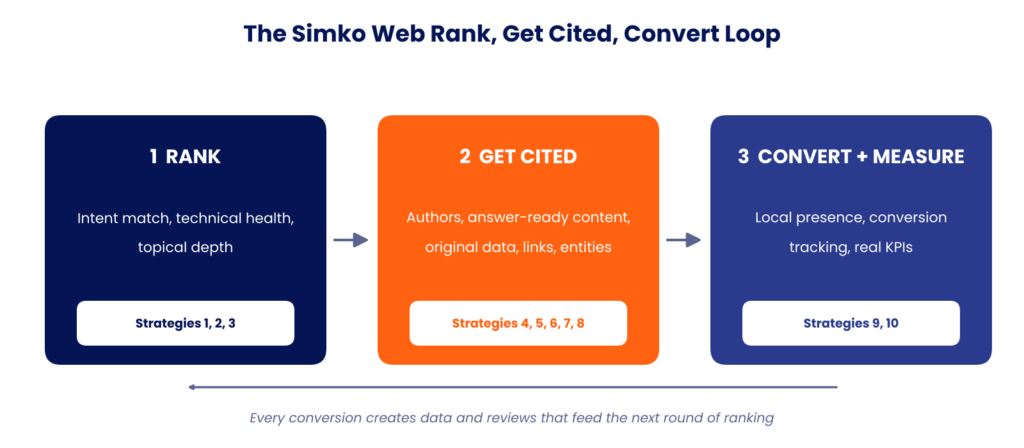
At Simko Web, our SEO team keeps running into the same thing: pages that rank respectably and still earn few clicks, because nothing about them says “choose me” or “quote me”. We fix this with a simple model we call the Rank, Get Cited, Convert loop. Rank means earning a place on the results page. Get Cited means being the source an AI answer or a journalist reaches for. Convert means the visit ends in a call or enquiry, and what you learn feeds the next round. Most agencies stop at stage one.
Practical Strategy: The 10 SEO Strategies for 2027
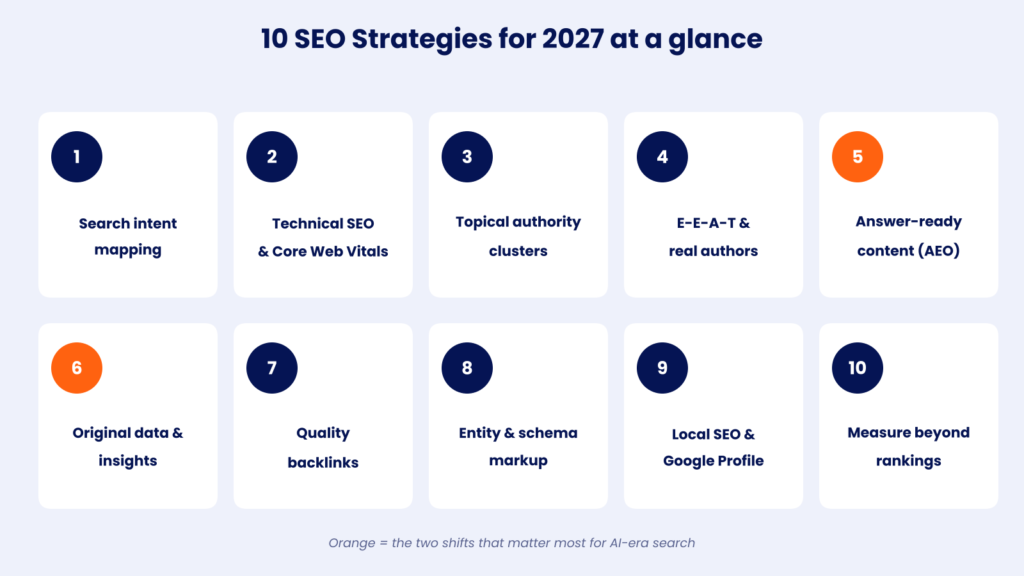
Here are the ten, in the order we would work through them. Each one is small enough to start this month.
1. Match Search Intent Before You Write a Word
Open the top five results for your target query and note what they actually are: guides, product pages, comparisons, local listings. If Google is showing comparison pages and you publish a sales page, it won’t rank however well it is written. Map every important page to one intent (learn, compare, buy or visit) and write to that. It is the cheapest ranking fix there is.
2. Fix Technical SEO and Core Web Vitals
Speed, mobile layout and crawlability are the floor. Check Core Web Vitals in Search Console, fix broken links and redirect chains, and keep your XML sitemap clean. On a mid-range Android phone over patchy 4G, a heavy hero image hurts real visitors first and your metrics soon after. Technical work isn’t glamorous, but great copy can’t rescue a slow page.
3. Build Topical Authority With Clusters
One page on “SEO” will never beat a site that covers the whole topic. Pick a core service, write one in-depth pillar page, then support it with six to ten pages answering the specific questions buyers ask, all linked together. For a Delhi dental clinic, that means implants, costs, recovery and aftercare, not forty posts on random health trends. Depth in a narrow area beats breadth.
4. Show Real E-E-A-T
Google’s quality systems reward experience and trust, and AI answers lean on sources they can verify. Put named authors on articles, add short bios with genuine credentials, show project photos and client results you can defend, and keep contact details and policies easy to find. A page that names its author and credentials is safer to quote.
5. Write Answer-Ready Content
Lead each section with a direct answer in two or three sentences, then expand. Use question-style subheadings, short paragraphs, tables for comparisons and a real FAQ block. This helps featured snippets, voice queries and AI Overviews pick up your wording, and it makes the page easier for humans to scan.
6. Publish Original Data and First-Hand Insight
AI tools can summarise what already exists, so they can’t replace what only you know. Run a small survey, analyse your own enquiry data, document a before-and-after from a real project, or publish price ranges drawn from actual quotes. Original findings get cited and linked; recycled advice gets ignored. If a paragraph could sit on any competitor’s blog, it won’t earn a citation.
7. Earn Quality Backlinks and Brand Mentions
A few relevant links from trusted sites beat hundreds of directory listings. Focus on digital PR, expert quotes for journalists, guest articles on industry sites and reclaiming broken links that point to you. Personalise every pitch. Neil Patel’s SEO templates guide makes the same point: outreach templates are starting points, and copy-pasted emails tend to get binned.
8. Use Schema and Entity Clarity
Help Google understand who you are. Add structured data for your organisation, articles, FAQs, products and local business details, and keep your name, address and descriptions consistent across your site, Google Business Profile and social profiles. Schema won’t rank a weak page, but it removes guesswork for machines deciding what your page is about. Only mark up what is visible on the page.
9. Win Local SEO With Your Google Business Profile
For any business serving a city, this is where enquiries often start. Claim and complete your profile, choose accurate categories, add services and photos, post updates and ask happy customers for reviews. Build location pages with real local detail rather than swapped-out city names. Local queries frequently trigger map results instead of AI summaries, so the opportunity is bigger than it looks.
10. Measure Beyond Rankings
Track what pays the bills: organic leads, calls, form fills and revenue. In Search Console, sort pages by impressions and look for those with weak click-through for their position. A title and meta description rewrite is often the quickest win, a workflow Neil Patel also recommends. Add a monthly check on whether AI tools mention your brand, and report it separately from clicks.
Step-by-Step Implementation: Your First 90 Days
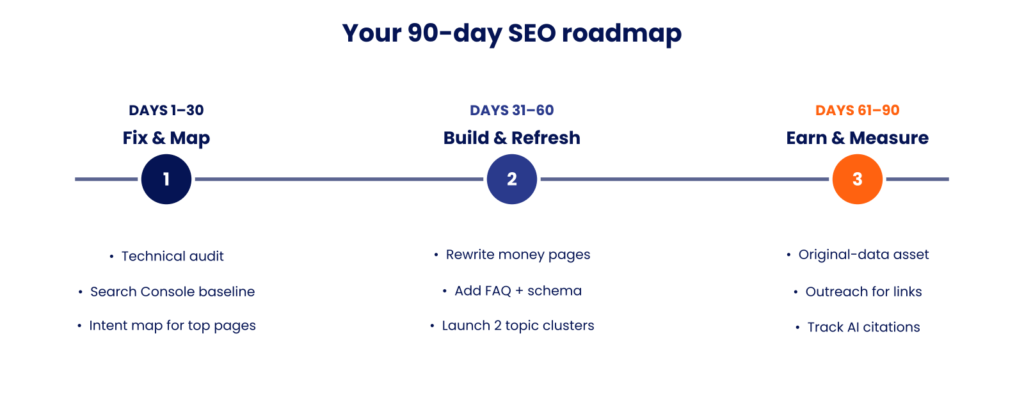
- Week 1: Export Search Console data and list your top 20 pages by impressions, with CTR and average position.
- Weeks 1–2: Run a technical audit. Fix anything that blocks indexing or slows mobile pages before touching content.
- Weeks 3–4: Map each key page to one intent and rewrite titles and meta descriptions on the low-CTR pages.
- Month 2: Launch two topic clusters around your highest-margin services. We usually start with whichever service already brings the best leads.
- Month 2: Add author bios, FAQ blocks and schema to every money page.
- Month 3: Publish one original-data asset and run personalised outreach around it.
- Month 3: Set up a monthly report covering leads, CTR and AI mentions. Then repeat.
Common Mistakes to Avoid
- Chasing keywords instead of intent. Stuffing a phrase into a page that answers a different question wastes the effort.
- Publishing unedited AI drafts. Generic text with no first-hand experience gives AI answers no reason to cite you.
- Panic-editing mid-update. Rewriting pages while a core update is still rolling out muddies your data. Compare a stable pre-update week with the weeks after it finishes.
- Buying cheap link packages. Irrelevant links add risk without adding trust.
Expert Perspective
We at Simko Web think the industry is overreacting in two opposite directions. Some agencies announce that SEO is dead because of AI search. Others rebrand the same old checklist as “GEO” and charge more for it. Neither helps a Delhi business that simply wants more enquiries. Our view: intent, authority, speed and trust still decide who gets surfaced, and AI search only raises the bar on being genuinely useful. If we had to cut this list to three, we would keep intent, original data and measurement.
Conclusion
SEO in 2027 rewards sites that are fast, trustworthy and genuinely useful, and that measure success in leads rather than positions. Start with intent, fix the basics, publish something only you could write, and track results monthly. If you would like a Delhi-based team to audit where your site stands, Simko Web’s SEO specialists are happy to help.
Frequently Asked Questions
Quick answers to the questions business owners ask us most about SEO strategies for 2027.
What is the best SEO strategy for 2027?
There is no single best tactic. The strongest approach combines intent-matched pages, a technically healthy site, genuine expertise and original content, and measurement tied to leads. If you must pick one place to begin, start with search intent.
Is SEO still worth it with AI Overviews?
Yes, but expect fewer clicks on informational queries. Pages cited in AI answers still earn visibility, and commercial and local searches continue to send visitors. Judge SEO by leads and revenue, not raw traffic.
How long does SEO take to show results?
Technical fixes and title rewrites can move numbers within weeks. Meaningful ranking gains from new content and links typically take three to six months, and longer in competitive niches.
Does AI-written content rank on Google?
Google evaluates whether content is helpful, not how it was produced. In practice, unedited generic output rarely performs. AI works best as a drafting aid that a human with real experience then improves.
How do I get cited in AI Overviews and AI Mode?
Rank well first, then make your pages easy to quote: direct answers, clear headings, named authors, structured data and original facts. Check regularly whether AI tools mention your brand for your key questions.
What are the most important Google ranking factors?
Google doesn’t publish a ranked list. Relevance to intent, content quality, page experience, authoritative links and trust signals consistently matter, so treat them as a system.
How many backlinks do I need?
There is no magic number. A handful of relevant, trusted links usually beats a large pile of weak ones. Compare the referring domains of pages already ranking for your target query.
Is local SEO important for small businesses in India?
Very. Searches with “near me” or a city name often show map results first. A complete Google Business Profile, steady reviews and accurate local details are among the highest-return tasks.
How often should I update existing content?
Review your top-performing pages every quarter and refresh anything outdated: statistics, screenshots, pricing and FAQs. Updating a page that already has traction often beats publishing a new one.
How can Simko Web help with my SEO?
Simko Web is a Delhi-based digital marketing agency, and our AI SEO team handles audits, content, technical fixes and link building for startups and established brands. We start with a baseline audit and a clear 90-day plan.