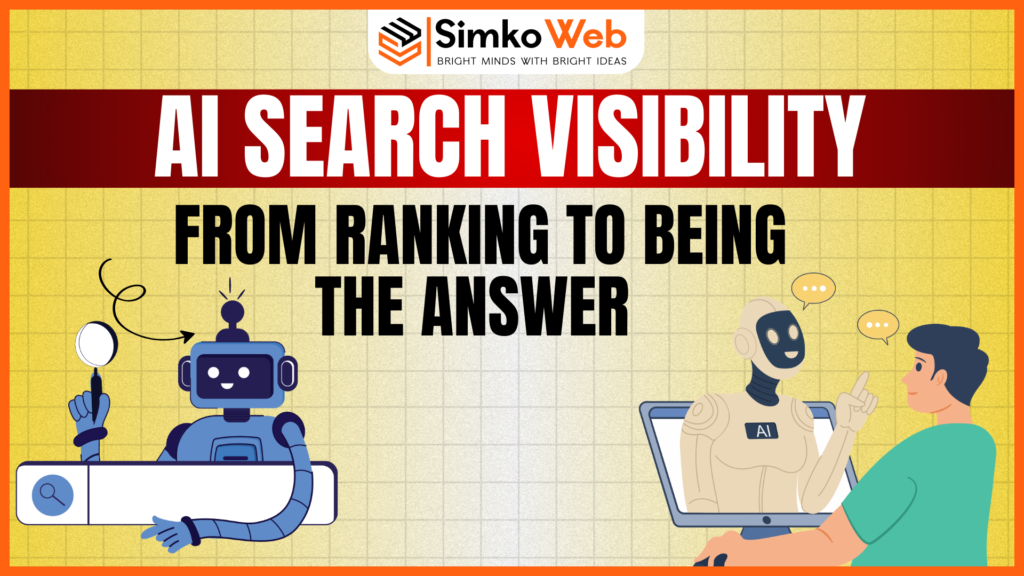
Beyond the Blue Link: Why “AI Search Visibility” is the New Ranking in 2026
The Day the Blue Link Stood Still
The Blue Link was our North Star for twenty years; today, it’s a relic of an “AI Search Visibility” era. For a quarter-century, we treated search engines as intermediaries—middlemen that directed users to destinations. But the behavioral transition that accelerated in 2025 has matured into a dominant discovery pattern. We have crossed the threshold from an era of information retrieval to the age of knowledge synthesis.
We now inhabit the “Answer-First Web.” Users are no longer following a navigational index; they are following answers across a fragmented ecosystem of conversational interfaces. The impact is staggering: we have entered the “Zero-Click Era,” where industry data confirms that over 60% of searches now resolve without a single click to a third-party website.
If your brand isn’t being synthesized into the response of a Large Language Model (LLM), you are effectively invisible to the fastest-growing segment of the market. To survive, you must pivot from traditional Search Engine Optimization (SEO) to the frontier of Generative Engine Optimization (GEO) and Answer Engine Optimization (AEO). This is your roadmap for reclaiming visibility in the age of the thinking machine.
——————————————————————————–
Takeaway #1: The 12% Overlap (Why SEO isn’t GEO)
One of the most dangerous assumptions in 2026 is that a #1 ranking on Google secures your spot in an AI summary. The “Search Index” is no longer the “Knowledge Base.” Research reveals a startling disconnect: the overlap between Google’s top 10 organic results and AI citations averages a mere 8% to 12%.
While Google AI Overviews (AIO) remain a hybrid outlier—with a 76% overlap due to their coupling with the legacy index—independent engines like ChatGPT and Perplexity use entirely different selection logic. Most tellingly, roughly 60% of Google AIO citations come from URLs that do not even rank in the top 20 organic results.
This happens because AI engines utilize Retrieval-Augmented Generation (RAG). They don’t just look for keywords; they “chunk” content to evaluate its extractability and topical authority. Traditional SEO is a “Ranking Machine” built for navigation; GEO is a “Thinking Machine” built for synthesis.
“The digital landscape of 2026 is defined by a fundamental transition from the era of information retrieval to the age of knowledge synthesis.”
——————————————————————————–
Takeaway #2: The Three-Month Expiration Date
In the generative ecosystem, freshness is a non-negotiable trust signal. We have entered the era of the “3-month citation cliff.” Research from AirOps indicates that pages not updated at least quarterly are 3x more likely to lose their AI citations.
LLMs exhibit a heavy “recency bias” because they are trained to reduce hallucination risk by prioritizing current data. In fast-moving sectors like SaaS and finance, the citation window is even tighter. If your content is older than 90 days, its probability of being retrieved for a commercial query drops off a cliff. To maintain authority, brands must move to a 90-day refresh cycle.
Critical Freshness Signals:
- lastModified Schema: Hard-coding the dateModified attribute to signal relevance to agentic crawlers.
- 90-Day Refresh Cycles: Auditing core pages quarterly to update statistics, pricing, and case studies.
- Provenance Tracking: Ensuring your “Date Updated” is visible and accurate to signal human oversight.
——————————————————————————–
Takeaway #3: Structure is the New Keyword (The BLUF Strategy)
AI systems do not “read”—they extract. To be citable, your content must favor a “Bottom Line Up Front” (BLUF) model. Most RAG systems evaluate a page’s relevance based almost exclusively on the first 200 words. If you bury the answer under a “narrative lead,” the AI will skip you for a competitor who provides a direct answer capsule.
Furthermore, sequential H2/H3 headers act as essential “pattern-matching” tools. Phrasing headers as exact conversational queries is now one of the highest-ROI changes you can make to your content architecture.
| Old Content Style | AEO Content Style (The Answer-First Model) |
| Long Lead-ups: Contextual building for several paragraphs before the “reveal.” | BLUF Answer Capsules: Direct, 30–60 word summaries at the immediate start of each section. |
| Keyword-Dense Headers: Vague titles like “GEO Strategy Overview.” | Semantic Question Headers: Exact queries like “How do I optimize for GEO in 2026?” |
| Narrative Blocks: Long paragraphs describing features or steps. | Extractable Structures: Heavy use of bulleted lists, comparative tables, and FAQ schema. |
——————————————————————————–
Takeaway #4: Reddit and the “Wisdom of the Crowd” Trust Layer
AI models increasingly treat peer validation as a credible proxy for trust, bypassing brand-owned marketing entirely. This has created a massive shift toward User-Generated Content (UGC) as a primary source of truth.
The data is transformative: brands are now 6.5x more likely to be cited via third-party sources than their own domains. In fact, 85% of brand mentions in AI search originate from third-party pages like Reddit, Quora, and YouTube.
Platform preferences vary: ChatGPT shows a “Wikipedia dominance” (accounting for nearly 48% of its top sources), while Perplexity leans heavily on Reddit (dominating 46.7% of its citations). If you aren’t visible in the “community layer,” you are invisible to the model.
“85% of brand mentions in AI search originate from third-party pages, not owned domains.”
——————————————————————————–
Takeaway #5: Share of Voice is the Only Metric That Matters
As click-through rates (CTR) become a ghost metric, AI Share of Voice (AI SoV) has emerged as the only KPI that matters for a business audience. AI SoV isn’t a ranking; it’s a weighted measure of influence. Because LLM responses are probabilistic, visibility is a zero-sum game: when one brand’s share increases, a competitor’s must decrease.
We calculate this through a weighted formula where position equals trust: Position Weight = 1 / Position (A 1st place mention = 1.00; a 3rd place mention = 0.33)
With only 30% of brands staying visible from one answer to the next, tracking your “Citation Share” and “Entity Strength Score” is the only way to measure dominance in a world where users never leave the chat interface.
——————————————————————————–
Takeaway #6: The Rise of Agentic Commerce
The frontier of 2026 is “Agentic Commerce.” We are no longer just marketing to humans; we are marketing to Autonomous Buyers—AI agents that make decisions, compare specifications, and execute purchases on behalf of users.
To be actionable for these agents, brands must shift from “N x M” complexity (individual integrations) to an “N + M” architecture using the Model Context Protocol (MCP). This allows LLMs to communicate directly with your live inventory, pricing, and APIs.
However, as automation scales, we are seeing the rise of the “Human Premium.” Users still visit sites to verify high-stakes AI answers. The “T” in E-E-A-T (Trustworthiness) is the final hurdle; your brand must be a “trusted, citable source” that an agent can verify and a human can rely on.
How Simko Web Helps Brands Build AI Authority
Developing brand authority for AI search requires a combination of SEO expertise, content strategy, and brand positioning.
The team at Simko Web helps businesses achieve this through:
- AI-focused SEO strategies
- authority-driven content marketing
- brand entity optimization
- reputation and backlink building
- advanced digital marketing campaigns
By combining traditional SEO with modern AI search optimization techniques, Simko Web helps businesses increase visibility, credibility, and long-term online growth.
The Future of Search Belongs to Authoritative Brands
AI search engines are reshaping how users discover brands online.
Success in this new environment depends on credibility, expertise, and consistent brand signals across the web.
Businesses that invest in brand authority today will gain a major competitive advantage as AI search continues to evolve.
With the right strategy and expert guidance from Simko Web, companies can position themselves as trusted sources that AI platforms confidently recommend.
——————————————————————————–
Conclusion: Future-Proofing for 2035
Search has moved from a destination to a network of trusted answers. To survive the next decade, your brand must transition from a “list of links” to an “indispensable authority.” The goal is no longer to game an algorithm, but to build a digital reputation that both humans and machines find impossible to ignore.
The Final Thought: Query Perplexity or ChatGPT about your industry’s hardest problems right now. Does your brand have a reputation that an AI would trust enough to recommend?
If you are invisible in the synthesis, the time for traditional SEO is over. An AI Visibility Diagnostic is the essential first step to reclaiming your voice in the era of the thinking machine.
1. What is AI brand authority?
AI brand authority refers to how AI search engines evaluate a brand’s credibility, expertise, and trustworthiness when generating search results.
2. Why is brand authority important for AI search?
AI platforms prioritize brands they trust. Strong authority signals increase the chances of your brand being cited in AI-generated answers.
3. How is AI SEO different from traditional SEO?
Traditional SEO focuses mainly on keywords and backlinks, while AI SEO emphasizes brand credibility, expertise, and entity recognition.
4. Do backlinks still matter for AI search visibility?
Yes. Backlinks from reputable websites help validate your brand’s authority and improve both SEO rankings and AI visibility.
5. What type of content builds the most authority?
Case studies, expert insights, data-driven articles, and real-world examples are the most powerful authority-building content types.
6. How can businesses improve AI search visibility?
Businesses can improve visibility by creating consistent branding, publishing experience-driven content, and earning third-party mentions.
7. How long does it take to build AI search authority?
Building strong AI brand authority usually takes 3–12 months, depending on the strength of your content strategy and digital presence.
8. Which industries benefit most from AI search optimization?
Industries like healthcare, SaaS, digital marketing, finance, and e-commerce benefit significantly from AI search visibility.
9. How do AI search engines choose which brands to cite?
AI systems analyze signals such as EEAT, backlinks, content quality, brand mentions, and structured data to decide which brands are credible.
10. Can a digital marketing agency help build AI authority?
Yes. Professional agencies like Simko Web specialize in building SEO authority, optimizing brand signals, and improving AI search visibility.
For More Information