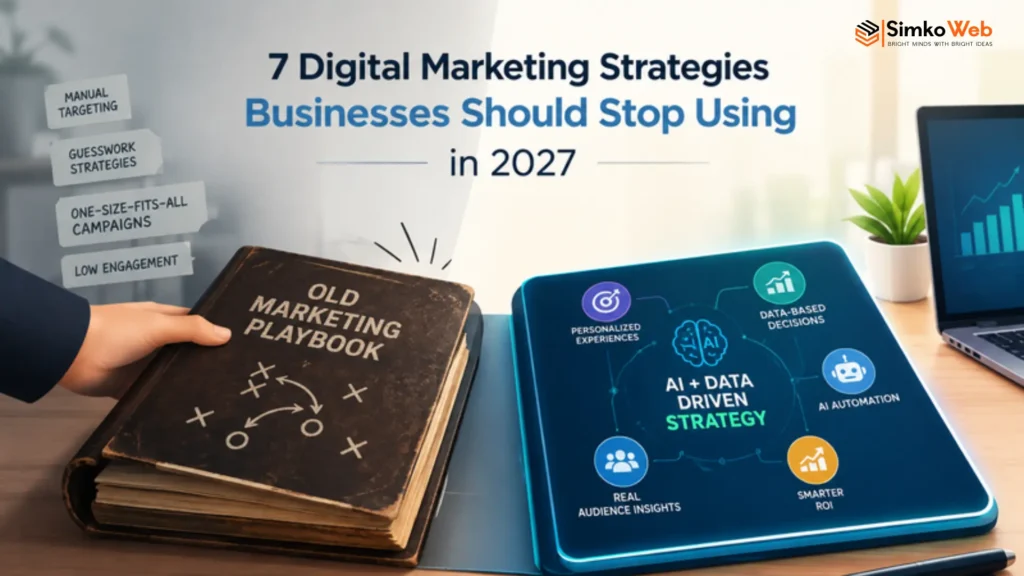
- Digital Marketing Strategies Businesses Should Stop Using in 2027
- Why This Matters Now
- The Core Problem
- What Businesses Need to Understand
- The 7 Strategies to Retire
- Original Insight: What We're Seeing in Client Accounts
- Practical Strategy for Making the Switch
- Step-by-Step Implementation
- Common Mistakes
- Expert Perspective
- Frequently Asked Questions
- Conclusion
Digital Marketing Strategies Businesses Should Stop Using in 2027
Every business we talk to at Simko Web has a version of the same worry: their marketing spend hasn’t dropped, but the results have. That’s rarely a budget problem. More often, it’s a handful of tactics still running on autopilot long after the platforms, the algorithms, and the customers moved on. Below are seven of the most common habits we see businesses hang onto into 2027 — and what’s worth doing instead.
Why This Matters Now
Three shifts are converging at once. Google’s search results are increasingly AI-generated rather than a list of blue links. Chrome’s move away from third-party cookies has pushed cross-site ad tracking toward first-party and consent-based data instead. And organic social reach has kept sliding — some platform studies put Instagram’s year-over-year reach decline in the double digits through 2026, with engagement rates on major platforms falling even faster. Strategies built for a pre-AI, cookie-based, high-organic-reach internet aren’t just slightly less effective now — several of them actively waste budget.
The Core Problem
Most marketing plans get updated in small increments — a new platform added here, a new tool there — without ever removing what no longer works. That’s how a strategy quietly becomes a museum of every tactic a business has tried since 2018. The fix isn’t more tactics. It’s a genuine audit of what to stop.
What Businesses Need to Understand
Not every ‘outdated’ tactic is dead — some just need a different execution. Email marketing, for instance, isn’t obsolete; renting or buying email lists is. Keywords still matter for SEO; stuffing them into unreadable sentences doesn’t. The strategies below are grouped that way deliberately: the problem usually isn’t the channel, it’s a specific habit within it that’s stopped paying off.
The 7 Strategies to Retire
1. Buying or renting email lists
Cold, purchased contact lists have always carried spam and reputation risk, and inbox providers have gotten far better at detecting and penalizing exactly this pattern. A purchased list doesn’t know your brand and won’t convert like one that opted in. Replace it with a genuine first-party list built through gated content, loyalty programs, or on-site sign-ups — smaller, but dramatically more responsive.
2. Keyword-stuffed content written for algorithms, not people
Cramming a target keyword into every other sentence used to nudge rankings. Now it actively works against a page, both in classic Google rankings and in whether an AI Overview or AI Mode answer considers the page worth citing at all. Simko Web’s content team plans around intent-based clusters instead — a handful of pages that genuinely and directly answer the questions real customers ask, with the keyword appearing naturally rather than forced.
3. Chasing third-party cookie-based retargeting as a primary strategy
Cross-site tracking cookies are becoming steadily less reliable — browser-level privacy protections in Safari and Firefox already limit them heavily, and Chrome has been moving the same direction. Building an ad strategy primarily around cookie-based retargeting means building on a foundation that keeps eroding. The businesses adapting well are investing in first-party data — their own email list, site behavior, CRM data — and using it for both targeting and measurement.
4. Static, feed-only social posting
Posting the same single-image update across every platform and hoping the algorithm rewards consistency is a losing bet in 2027. Organic reach on static posts has kept shrinking across nearly every major platform, while short-form video and content built for on-platform conversation continue to outperform it. That doesn’t mean posting more — it means posting less, more deliberately, in the format each platform actually rewards.
5. Vanity-metric reporting (followers and likes as the headline number)
A growing follower count feels like progress, but it’s stopped being a reliable signal of business results — reach per follower has fallen sharply industry-wide, so a bigger audience doesn’t guarantee more people actually see a post. Reporting should center on metrics tied to revenue: qualified leads, cost per acquisition, and assisted conversions, with followers and likes kept as a supporting stat, not the headline.
6. Generic, one-size-fits-all ad creative across every channel
Running the same static banner and copy across Google, Meta, and LinkedIn ignores how differently people behave on each platform. What earns a click in a Google search ad rarely performs the same way as a scroll-stopping Reel or a professional LinkedIn post. Creative needs to be built per-platform now, even when the underlying offer is identical.
7. Treating AI-generated content as a finished product
Publishing AI-drafted content without a real edit, fact-check, and infusion of first-hand expertise is one of the fastest ways to end up invisible in 2027 — both because readers can tell, and because Google’s systems have specifically said they’re reducing the visibility of generic, low-value AI content in features like Discover. AI is a legitimate first-draft tool, not a substitute for a strategist’s judgment and a business’s actual expertise.
Original Insight: What We’re Seeing in Client Accounts
Across the accounts our team has audited this year, the single most common pattern isn’t a business using one of these seven tactics badly — it’s a business that adopted a newer channel (AI-assisted content, first-party email capture, short-form video) while still quietly running two or three of the old habits in parallel, usually because nobody explicitly decided to stop. Retiring a tactic takes a specific decision. Simko Web’s audits usually start there: not ‘what should we add,’ but ‘what should we finally stop.’
Practical Strategy for Making the Switch
Don’t try to fix all seven at once. Sequence it:
- Audit current spend and effort against this list — which of the seven is your business still running, and how much budget or time does it consume?
- Replace, don’t just remove — pair each retired tactic with its modern equivalent (e.g., purchased lists → first-party capture) rather than leaving a gap.
- Re-baseline your reporting before judging results — vanity metrics will often drop as you shift focus to metrics that actually predict revenue, and that’s expected, not a failure.
Step-by-Step Implementation
1. List every active channel and tactic. Get the full current picture on paper before deciding what to cut — it’s usually more than people expect.
2. Flag anything matching the seven above. Be honest about habits kept out of convenience rather than performance.
3. Set a modern replacement for each flagged tactic. Simko Web typically pairs this step with a short first-party data or content audit so the replacement is grounded in what’s actually available to the business.
4. Set a 90-day checkpoint. Old habits creep back in without a scheduled review — put one on the calendar now.
5. Re-train whoever executes day-to-day. Most of these habits persist simply because the person posting or writing was never told to stop — make the change explicit, not implied.
Common Mistakes
- Cutting a tactic without replacing it, leaving a genuine gap in lead flow rather than an improvement.
- Judging the switch too early — first-party data strategies and intent-based content both take longer to show results than the old tactics did, but tend to be far more durable.
- Assuming ‘stop using AI content’ means avoiding AI tools entirely, rather than simply requiring real editing and expertise on top of them.
- Keeping vanity metrics as the primary report to leadership because they’re easier to explain, even after the team has agreed they’re not the right measure.
Expert Perspective
At Simko Web, the pushback we hear most often isn’t ‘this tactic doesn’t work’ — it’s ‘we’ve always done it this way.’ That’s a comfort argument, not a performance one. Every tactic on this list was, at some point, the smart move. The businesses that struggle in 2027 aren’t the ones who chose wrong in 2020; they’re the ones who never revisited the choice. A marketing strategy needs the same maintenance schedule as anything else that degrades quietly over time.
Frequently Asked Questions
A few questions we hear often when businesses start this kind of audit:
Is email marketing itself outdated?
No — email marketing remains one of the highest-ROI channels available. What’s outdated is buying or renting cold lists rather than building a genuine first-party list.
Should businesses stop using keywords in content entirely?
No. Keywords still matter for both traditional SEO and AI search visibility. The outdated habit is forcing them unnaturally into every sentence rather than writing content that genuinely answers the underlying question.
What should replace third-party cookie-based retargeting?
First-party data — your own email list, on-site behavior, and CRM data — paired with contextual and consent-based targeting. It takes more setup but doesn’t erode the way cookie-based tracking has.
Why has our social media reach dropped even though we’re posting consistently?
Organic reach has declined across nearly every major platform, particularly for static, feed-only posts. Consistency alone no longer overcomes an algorithm that increasingly favors short-form video and content built for on-platform interaction.
Are follower counts and likes worth tracking at all?
They’re fine as a secondary signal, but shouldn’t be the headline metric in a marketing report. Track metrics tied to revenue — qualified leads, cost per acquisition, conversion rate — as the primary measure.
Is using AI for content creation itself a mistake?
No — used as a first draft or research aid, AI tools can genuinely speed up content production. The mistake is publishing that output without real editing, fact-checking, and first-hand expertise layered on top.
How long does it take to see results after switching away from these tactics?
Typically longer than the old tactics took to show a (declining) result — often a full quarter or two for first-party data and content-strategy changes to fully show up in reporting. Set expectations for that timeline up front.
Do small businesses need to worry about all seven of these?
Most small businesses are only actively running two or three of the seven. The audit step — checking which apply — matters more than assuming all of them do.
What’s the single highest-priority tactic to retire first?
For most businesses Simko Web audits, it’s either purchased email lists (a direct reputation and deliverability risk) or keyword-stuffed content (actively working against both classic SEO and AI search visibility). Start with whichever one is currently doing active harm rather than just underperforming.
How can Simko Web help with this kind of audit?
Our team runs a full marketing-channel audit against exactly this list — flagging which legacy tactics a business is still running, and building the first-party data, content, and social strategy to replace them.
Conclusion
None of these seven tactics fail because the underlying channel is dead — email, SEO, retargeting, and social all still work. They fail because the specific habit inside each channel stopped matching how customers, algorithms, and privacy rules actually behave in 2027. A short, honest audit against this list is usually enough to find real budget currently being spent on strategies quietly working against the business rather than for it.