- Understanding AI SEO Strategy: Why the Fundamentals Never Changed
- Why AI Search Doesn't Change Core SEO Principles
- AI SEO Best Practices for 2026: Content That Works Across Search Formats
- AI Overviews SEO: Understanding Query Fan-Out and Visibility
- Addressing the Client Communication Challenge in AI SEO
- SEO Checklist for AI Search Success in 2026
- Common AI SEO Misconceptions to Avoid
- Future-Proofing Your Content Strategy for Emerging Search Formats
- Frequently Asked Questions About SEO for AI
- Conclusion: The Enduring Principles of Content Success
Understanding AI SEO Strategy: Why the Fundamentals Never Changed
The digital marketing landscape has shifted dramatically with the rise of AI-powered search results, but Google’s perspective remains surprisingly consistent. During a recent Search Off the Record episode, Google’s Danny Sullivan and John Mueller addressed the growing confusion around AI SEO strategy, delivering a message that might surprise many practitioners: SEO for AI is still SEO.
This statement carries profound implications for businesses investing in separate AI search optimization strategies. Rather than requiring entirely new tactics, AI search capabilities demand that marketers return to core principles they may have abandoned in pursuit of algorithmic advantages.
The proliferation of acronyms—GEO (Generative Engine Optimization), AEO (Answer Engine Optimization), SEO, and others—suggests fundamental shifts in optimization approaches. Yet Google’s position clarifies that these are simply different interfaces for delivering what has always mattered: quality content created for humans first.
Why AI Search Doesn’t Change Core SEO Principles
Google’s north star for search has remained consistent for over two decades: reward content created for people. This principle applies equally to traditional blue link results and AI-powered experiences. Sullivan emphasized that creating content specifically for search algorithms—whether traditional or AI-based—actually poses a risk. When you optimize narrowly for a specific AI system, you create a permanent catch-up problem as those systems inevitably evolve.
The solution Google recommends is straightforward: if you’re already creating high-quality content for humans, you’re already “ahead” as search formats shift. This reframes AI optimization from a technical challenge into a content quality challenge.
AI SEO Best Practices for 2026: Content That Works Across Search Formats
Creating Original Value in AI-First Search
One of the clearest differentiators in AI search results is originality. Google increasingly penalizes commodity content—information that can be easily generated or served as a direct answer. Pages that merely pad simple facts into longer articles eventually lose visibility to direct answers and data feeds.
What constitutes original value:
- Unique perspective and expertise: Content that brings specialized knowledge only you possess
- Original research and reporting: Data, studies, and insights from your own investigations
- Firsthand experience: Practical knowledge gained through direct involvement
- Distinctive voice: Communication style that’s authentically yours, not manufactured
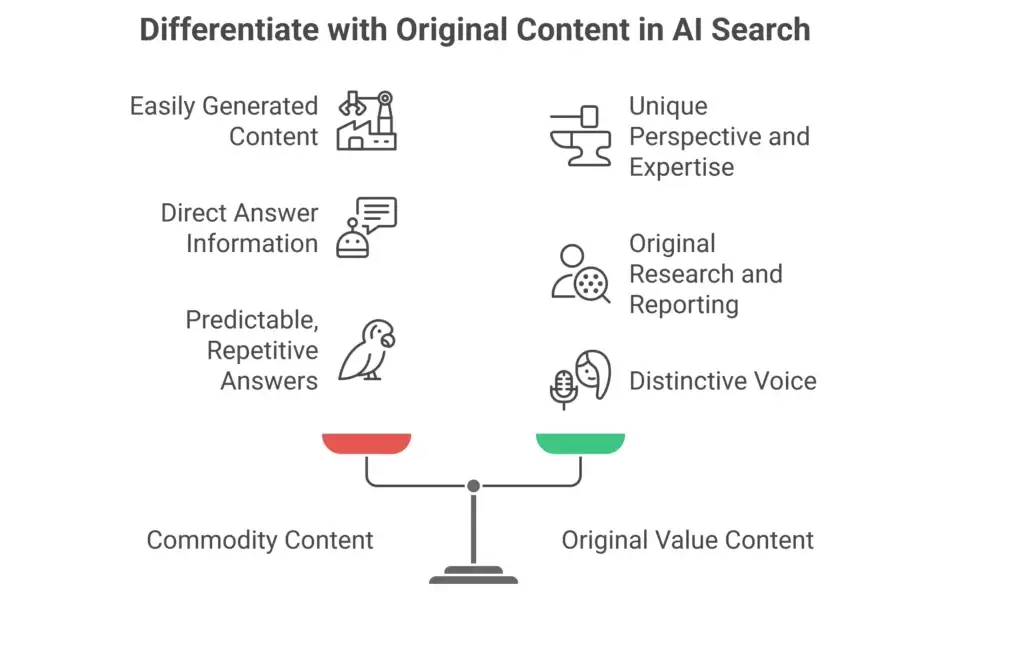
Sites built on predictable, repetitive answers face the highest risk. Word game solution sites, template-based how-to guides, and FAQ pages optimized purely for ranking find themselves displaced when AI systems can supply that information natively.
The winning strategy is to build content authority around topics where you have genuine expertise. Data journalism, original research, market comparisons, and correlation studies create content that AI systems and users both value.
Multimodal Content Optimization for AI Algorithms
Google recommends a multimodal approach to content creation—mixing text with images and video to match how different audiences consume information. Users don’t search in one format; they search across formats and demonstrate clear preferences based on query type.
Format preferences across search queries:
- How-to queries: Video content often outperforms text-only articles
- Product comparisons: Images and interactive elements enhance understanding
- Educational content: Combination of text explanations, diagrams, and visual demonstrations
- News and updates: Embedded graphics and infographics improve engagement
Modern AI systems evaluate content quality across multiple dimensions, including visual elements. A page with text, relevant images, and supporting video provides AI systems with richer context for understanding and presenting your content.
This doesn’t mean every piece of content requires all formats. Rather, add multimodal elements where they genuinely improve understanding for your audience. AI systems can distinguish between authentic multimedia enhancement and unnecessary filler.
Structured Data for AI Search: Beyond Basic Markup
Structured data remains important in AI SEO, though many misunderstand its role. The misconception that “structured data equals AI ranking advantage” has led to inefficient optimization efforts. Google clarifies that structured data is supportive, not decisive—it helps systems understand and present content accurately, similar to its role in traditional search features.
How structured data matters in AI search:
- Better interpretation: Helps AI models understand context and meaning
- Rich result eligibility: Increases chances of enhanced display formats
- Featured snippet positioning: Improves likelihood of appearing in AI Overviews
- Accuracy in representation: Ensures your brand information displays correctly across systems
Pages with properly implemented structured data experience up to 30% higher click-through rates due to enhanced visibility. Schema.org markup helps AI engines extract clean, reliable, context-rich information that better represents your offerings.
Best schema types for AI optimization:
- FAQ Schema: Answers direct questions, often pulled into AI summaries
- Article Schema: Clarifies publication date, author, and content type
- Organization Schema: Establishes authority and credibility signals
- LocalBusiness Schema: Critical for location-based AI results
- Product Schema: Essential for e-commerce content appearing in AI comparisons
AI Overviews SEO: Understanding Query Fan-Out and Visibility
Why Ranking in Blue Links Doesn’t Guarantee AI Overview Visibility
Many SEOs report ranking in traditional search results but not appearing in AI Overviews, leading to frustration. John Mueller explained this seeming paradox through the concept of “query fan-out.” AI features run multiple related searches behind the scenes, synthesizing results rather than returning answers for the exact query typed.
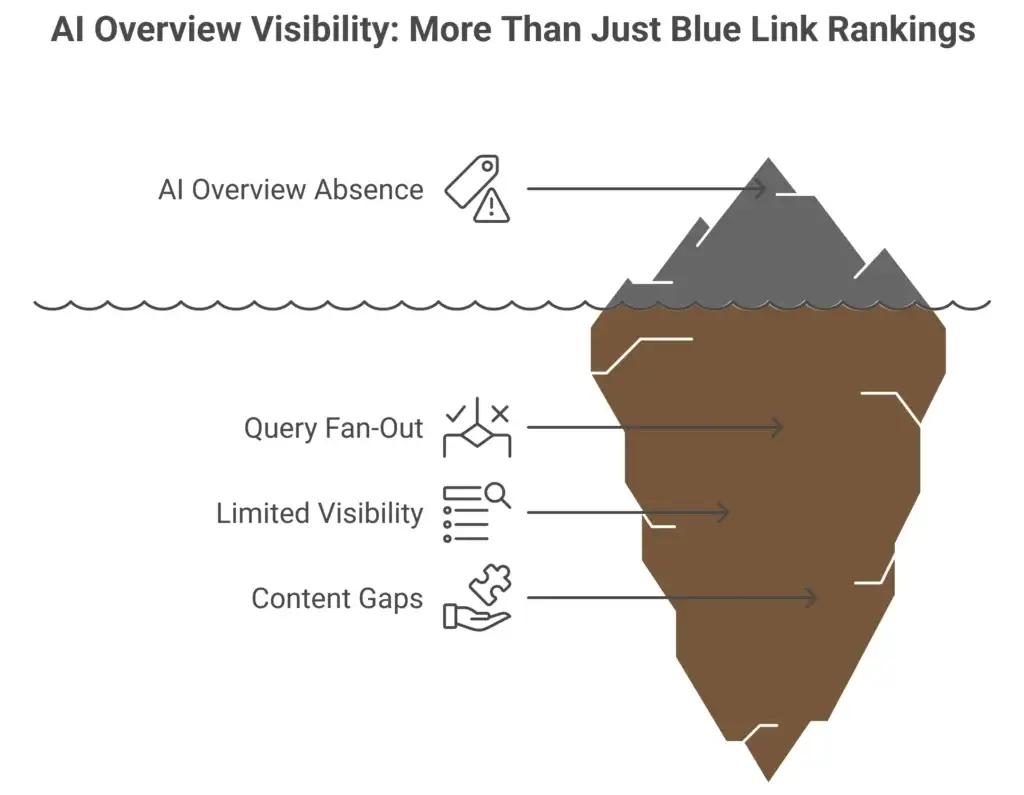
Query fan-out example:
A user searching “best digital marketing strategies” might trigger AI systems to query:
- “digital marketing trends 2026”
- “marketing channel comparison”
- “ROI by marketing channel”
- “emerging marketing technologies”
- “marketing automation benefits”
Your site might rank well for one of these queries but not all. AI synthesis requires visibility across multiple related searches to appear in the Overview.
Implications for AI SEO strategy:
This means visibility in AI results doesn’t map one-to-one with exact query rankings. You might rank for your primary target keyword but miss the AI Overview if you lack visibility for related search variations. The solution is creating topically comprehensive content that addresses related questions and search angles.
Quality Clicks Over Traffic Volume in AI Search Results
Google observes that traffic from AI Overviews often arrives more engaged than traditional search traffic. Users clicking from AI results tend to spend more time on-site and convert at higher rates. Sullivan’s hypothesis: AI systems create better contextual awareness, so users click only when confident the result matches their intent.
This insight shifts the optimization metric from raw traffic volume to quality conversions. Rather than pursuing maximum impressions, focus on attracting the right audience at the right intent level.
Reframing success metrics:
- Define business outcomes clearly: What constitutes a conversion for your business?
- Track engagement signals: Time on-site, pages per session, bounce rate
- Monitor conversion quality: Are AI-driven users completing valuable actions?
- Analyze intent matching: Do incoming visitors have genuine need for your offerings?
This approach aligns incentives: AI systems preferentially show content that delivers genuine value to searchers, and those systems reward your site with more engaged traffic.
Addressing the Client Communication Challenge in AI SEO
How to Position Traditional SEO as AI-Era Strategy
Sullivan acknowledged a real-world tension: clients still demand “AI optimization” as a separate service offering. This creates pressure for agencies and in-house teams to appear to be doing something novel.
The reframing Sullivan suggests is elegant: position core SEO strategy as the durable approach that works across all search formats, including AI. Rather than building a second content system for AI, position your AI strategy as continuous monitoring and adaptation.
Client communication framework:
Instead of: “We’re adding AI SEO services”
Try: “We’re implementing AI-era content strategies that work across Google Search, AI Overviews, and emerging discovery formats”
This positions you as forward-thinking while avoiding the impression of overcomplicating strategy or doubling work. The reality: best-practice AI content strategy is best-practice SEO, implemented consistently.
Monitoring and Adaptation vs. Content Rebuilding
Many agencies suggest rebuilding entire content systems for AI optimization. Google’s guidance is more pragmatic: implement monitoring systems and adapt existing content rather than starting from scratch.
Practical adaptation approach:
- Audit existing content for originality, expertise, and unique perspective
- Identify content gaps where competitors provide more comprehensive coverage
- Enhance topical depth by addressing related questions and search variations
- Implement structured data where schema types support your content type
- Monitor AI Overview visibility alongside traditional rankings
- Refine based on performance data from both traditional and AI search results
This incremental approach requires less investment than content rebuilding while delivering meaningful improvements in AI search visibility.
SEO Checklist for AI Search Success in 2026
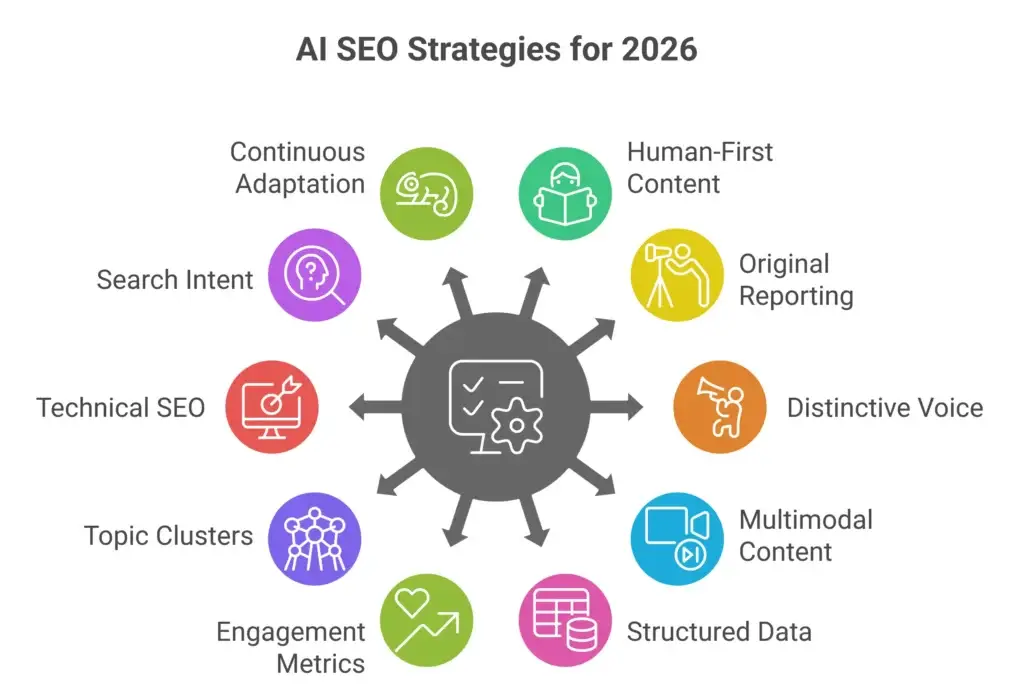
Google’s guidance translates into a practical checklist for businesses implementing AI-era SEO strategies:
✓ Create human-first, satisfying content
Focus on audience needs and satisfaction rather than algorithm optimization. Quality that serves humans serves AI systems.
✓ Offer original reporting, expertise, and firsthand experience
Bring unique perspective that can’t be easily replicated. Data, research, and genuine insights differentiate your content.
✓ Develop a distinctive voice and perspective
Authenticity matters. Genuine expertise and authentic communication create content that stands out from generic alternatives.
✓ Add images or video when genuinely improving understanding
Multimodal content serves different learning preferences and provides richer context for AI systems.
✓ Implement structured data appropriately
Use schema markup that matches your content type and genuinely clarifies information for AI systems.
✓ Optimize for engagement and conversions, not just clicks
Track quality metrics that matter to your business rather than chasing traffic volume.
✓ Build content authority around topic clusters
Create comprehensive coverage of topics where you have expertise, addressing related questions and search variations.
✓ Maintain technical SEO foundations
Site speed, Core Web Vitals, mobile optimization, and proper indexing remain baseline requirements.
✓ Align with search intent at every stage
Understand why people search, not just what they search for.
✓ Monitor and adapt continuously
AI systems and search results evolve; successful strategy requires ongoing optimization rather than one-time implementation.
Common AI SEO Misconceptions to Avoid
Myth 1: You Need Separate Content Systems for AI
Reality: Optimizing content for AI doesn’t require separate systems or duplicate content. The same content optimized for humans works across discovery formats. Building separate AI content actually risks consistency and creates maintenance challenges.
Myth 2: Structured Data Automatically Ranks You in AI Overviews
Reality: Schema markup is supportive, not decisive. Proper implementation improves your chances of visibility, but content quality and topical relevance matter more. Google explicitly states it’s not “structured data and you win AI.”
Myth 3: Commodity Content Still Works in AI Search
Reality: Direct answer features and AI systems make commodity content increasingly vulnerable. Generic, templated answers get replaced by native AI summaries. Originality and unique perspective become key differentiators.
Myth 4: Ranking Position Determines AI Overview Visibility
Reality: Query fan-out means AI visibility depends on coverage across related searches, not just ranking for the exact query typed. Topical comprehensiveness matters more than single-query ranking.
Myth 5: You Should Optimize Narrowly for Specific AI Systems
Reality: Narrow optimization for specific systems creates permanent catch-up problems as systems evolve. Human-first optimization provides better long-term resilience.
Future-Proofing Your Content Strategy for Emerging Search Formats
The principle underlying all this guidance is elegant: optimize for humans, and your content survives across search formats. Whether the next innovation is AI Overviews, answer engines, voice search integration, or something currently unforeseen, content built on human satisfaction and original value adapts naturally.
This approach also aligns with broader industry trends. Pages with high content quality, authentic expertise, and strong engagement signals consistently outperform in emerging search formats. The future of search rewards the same principles that rewarded good content in 2015: genuine value, expertise, and audience focus.
Frequently Asked Questions About SEO for AI
1: Is Traditional SEO Dead With the Rise of AI Search?
No. Google explicitly states that SEO fundamentals remain unchanged in AI search environments. If you’re already creating quality content for humans and implementing solid technical SEO, you don’t need to overhaul your strategy. However, you should monitor your visibility in AI Overviews and adapt content to address topical gaps revealed by AI visibility analysis. The core remains the same; the emphasis shifts from narrow ranking optimization to comprehensive topical coverage.
2: What’s the Difference Between SEO, AEO, and GEO?
A: These acronyms represent different discovery interfaces rather than fundamentally different optimization approaches. AEO and GEO are newer terms for optimizing content for AI-powered systems, but the underlying principles remain consistent with traditional SEO. Rather than implementing three separate strategies, implement one human-first content strategy that works across all formats. The specific technical optimizations might vary slightly, but the core content quality and expertise requirements don’t change.
3: How Important Is Structured Data for AI Rankings?
A: Structured data is important but not decisive. Proper schema implementation helps AI systems better understand and represent your content, increasing chances of rich result visibility and AI Overview inclusion. However, content quality, originality, and topical comprehensiveness matter more. Think of structured data as supportive infrastructure that helps your quality content perform better, not as a ranking factor that overrides content quality. Studies show pages with structured data achieve 30% higher click-through rates, but this results from enhanced visibility for already-quality content, not from schema alone.
4: Should I Create Separate Content for AI Systems?
A: No. Creating separate content systems introduces complexity, consistency risks, and maintenance challenges without corresponding benefits. Content optimized for humans works across discovery formats. Instead of separate systems, implement unified content creation that emphasizes human value and topical comprehensiveness. AI systems can serve the same content through different interfaces. The distinction is in how AI systems surface your content, not in how you should create it.
5: How Do I Rank in AI Overviews if I Already Rank in Blue Links?
A: This often results from query fan-out—AI systems run multiple related searches behind the scenes and synthesize results. You might rank well for your exact target query but lack visibility for related searches that AI synthesis requires. Solution: audit your topical comprehensiveness by analyzing which related questions AI Overviews synthesize for your target topic, then develop content addressing those related angles. This topical cluster approach increases visibility across multiple searches that feed into AI Overviews.
6: What Structured Data Types Should I Implement First?
A: Prioritize schema types matching your content. FAQ Schema works well for Q&A content often pulled into AI summaries. Article Schema helps clarify publication details. Organization or LocalBusiness Schema establishes authority signals. Product Schema is essential for e-commerce comparison queries. Rather than implementing all schema types, focus on those genuinely clarifying your content. Proper implementation of relevant schema matters more than comprehensive implementation of irrelevant types. Start with your primary content type and expand based on performance data.
7: How Should I Measure Success With AI Search Visibility?
A: Shift focus from volume metrics (traffic, impressions) to quality metrics that indicate genuine user satisfaction. Track engagement signals like time-on-site, pages per session, and bounce rate for AI-driven traffic. Monitor conversion rates specifically for visitors from AI results. Analyze intent-matching—are incoming users qualified prospects? Compare these quality metrics between AI and traditional search traffic. Google notes that AI-driven traffic often shows higher engagement, so if your AI traffic underperforms on these metrics, it indicates positioning or content issues. Define clear conversion goals specific to your business model and track those religiously.
8: What Role Does Content Authority Play in AI Search?
A: Content authority in AI search comes from topical comprehensiveness and genuine expertise. Create content clusters addressing related questions and search angles within your expertise area. Original research, data journalism, case studies, and comparative analysis signal expertise to AI systems. Earn external mentions and citations within your topic area. Develop your unique perspective through consistent, high-quality content over time. Authority builds gradually; it’s not something schema markup or single optimization changes create. Focus on becoming the obvious choice for your expertise area across multiple content pieces addressing different angles.
9: How Often Should I Update Content for AI Search Optimization?
A: Regular updates help maintain visibility, but frequency depends on topic velocity. News and trending topics require frequent updates to remain relevant. Evergreen content needs updates less frequently but benefits from periodic refreshes to address emerging search angles. Google suggests monitoring AI Overview visibility for your topics and updating content when you identify topical gaps revealed by AI synthesis. Rather than updating on a fixed schedule, implement monitoring that triggers updates when performance data indicates changes are needed. Quality refresh beats arbitrary update schedules.
10: How Do I Communicate AI SEO Changes to My Leadership or Clients?
A: Frame the message around consistency and resilience rather than minimal change. Explain that AI search rewards the same content characteristics that always worked: human value, genuine expertise, and comprehensive topical coverage. Present this as positive—you don’t need to overhaul everything or hire additional specialists. Position your approach as forward-thinking strategy that works across Google Search, AI Overviews, and future discovery formats. Use concrete examples of how content changes improve both traditional rankings and AI visibility simultaneously. The narrative shifts from “we’re chasing the latest trend” to “we’re implementing durable strategy that adapts to emerging formats.” This positions leadership and clients for realistic expectations and demonstrates thought leadership rather than panic-driven changes.
Conclusion: The Enduring Principles of Content Success
Google’s message through Danny Sullivan and John Mueller is clear: the fundamentals of good SEO remain constant even as search interfaces evolve. Content created for humans, rooted in genuine expertise, and optimized across multiple formats performs well in both traditional search and AI-powered systems.
The pressure to develop “new” AI SEO strategies creates unnecessary complexity. Instead, refocus on core principles: create original value, demonstrate authentic expertise, build topical authority, and optimize for user satisfaction rather than algorithmic tricks. This approach is less trendy than specialized AI optimization, but it’s more resilient and effective across the long term.
As search continues to evolve, this principle will remain true: optimizing for humans optimizes for search, regardless of which interface surfaces the results.